
Expandable Flake Graphite
Learn how expandable flake graphite is created through intercalation, how exfoliation works, and how heat and chemical aging affect its expansion performance.
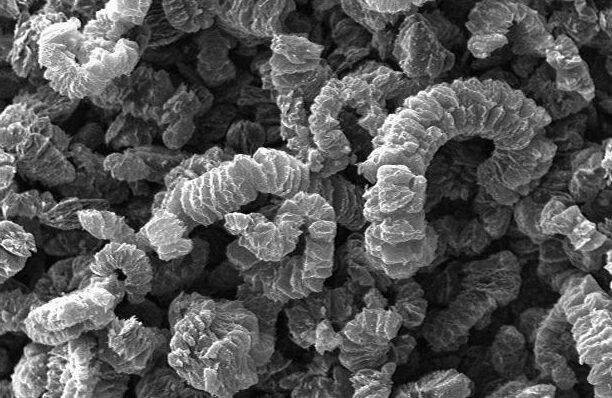
Learn more about intercalation and exfoliation, and see the results of heat aging and chemical aging studies.
What is intercalation?
Intercalation is the insertion of molecules or ions of one material between the layers of another. After intercalation the resulting material takes on new properties that are a function of the intercalant and the way it associates with the host species. Chemical and physical properties may be affected.
A wide variety of chemicals have been used to intercalate graphite materials. These include halogens, alkali metals, sulfate, nitrate, various organic acids, aluminum chloride, ferric chloride, other metal halides, arsenic sulfide, thallium sulfide, and others. The primary type of intercalation compound described here uses sulfate and is sometimes called “bisulfate.” The material that results is highly intumescent and may be used in fire retardants, high-performance gaskets, conductive fillers, electromagnetic pulse and radiation shielding, and foundry products.
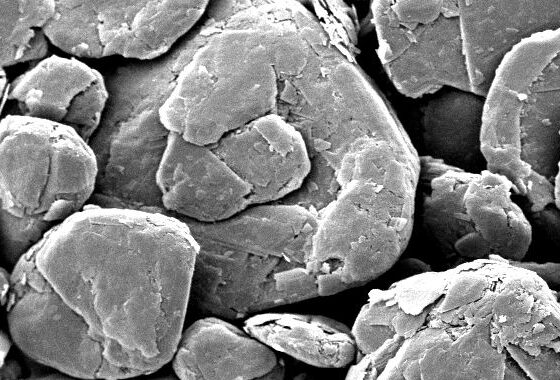
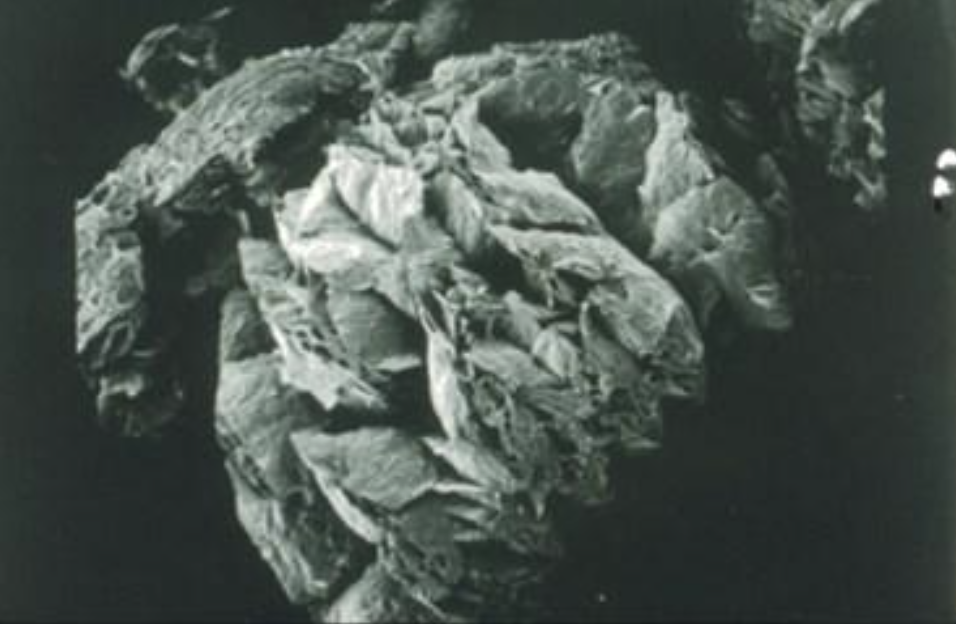
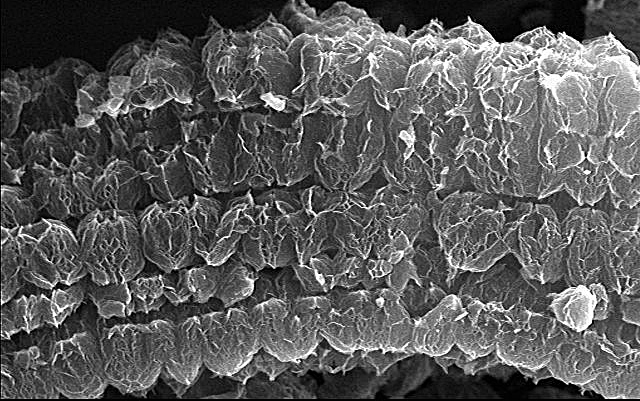
Micrographic Views of Intercalation
The scanning electron micrographs, above, show an actual graphite flake before and after expansion/exfoliation. High temperature causes the expansion agent to gasify, producing enough pressure to push adjacent layers apart.
The Effects of Intercalation
Intercalation results in a material with a variety of benefits and uses. The primary reason for bisulfate intercalation is to impart the ability of the treated flake graphite to intumesce, exfoliate, or expand. For a concise overview of properties and applications, see the Expandable Flake Graphite material page.
What is exfoliation?
Volumetric expansion
Specifically, expansion resulting from crystallographic de-lamination, which typically results in a material with increased chemical reactivity.
A result of heating
The actual cause of expansion/exfoliation is the increase in volume, and resultant pressure, caused by rapid heating of the intercalant.
Dependent on particle size
In general, particle size is directly proportional to expansion ratio. A bigger, thicker flake will typically have a higher expansion ratio than a smaller flake.
Particle Size Model
Along with heating temperature and speed, particle size has the most impact on the expansion and exfoliation process. Modeling a flake as a disc—a reasonable assumption since flake graphite is somewhat hexagonal in outline—the figure below illustrates this. Although not to scale, the value of “h” represents the interlayer or graphene layer spacing of the crystal. This space is where any vaporized intercalated species would exit the crystal. Discounting any defects or variation in interlayer spacing due to the insertion of the intercalant, the value of “h” is constant at 3.35 Å. The radius of the disc element illustrated is “r,” and the total area available for gas escape from a single layer equals 2prh, while the volume from which intercalant gas is produced equals pr2h. If one looks at the ratio of edge area to disc volume, 2prh /pr2h, it can be seen that the ratio varies as 2/r. As the radius decreases, the ratio 2/r gets very large.
Heat Aging Study
Introduction
The Technical Services Department of Asbury Advanced Materials performed a study to determine the effects of prolonged heating on the expandability of Asbury 3393 intumescent flake graphite. The results may provide some indication about the in situ behavior of articles containing this material that have been exposed to above-normal temperatures.
Methods and Materials
Product Description: The product 3393 is acid intercalated flake graphite used as an intumescent material in fire retardant applications. It typically contains 2-3% sulfur, present as intercalated sulfuric acid. The nominal sizing of 3393 is -20 +50 mesh (primarily particles between 850 and 300 micrometers in size).
Test Method: Ten samples of 3393 were placed into 5 cm diameter Petri dishes and heat treated at the prescribed test temperature in a Thermolyne programmable muffle furnace. The furnace was pre-heated for all heat treatment temperatures. Samples were left in the furnace for between one and 10 days each. For example, sample #1 was maintained at the test temperature for 24 hours, while sample #10 was maintained at the test temperature for 240 hours. After the prescribed test time, each sample was removed from the furnace and checked for percent heat expansion. Heat expansion was measured at 950º C using Asbury’s Test Method E4-4.
Overall Expansion Ratio as a Function of Oven Residence Time and Temperature.
| Temperature | 120 | 140 | 180 | 200 | 220 | 240 | 260 | 300 |
|---|---|---|---|---|---|---|---|---|
| Day | Expansion | |||||||
| 1 | 240 | 240 | 240 | 240 | 200 | 180 | 160 | 100 |
| 2 | 240 | 240 | 240 | 240 | 180 | 180 | 160 | 100 |
| 3 | 240 | 240 | * | 220 | 180 | 180 | 160 | 80 |
| 4 | 240 | 240 | 240 | 220 | 180 | 180 | 160 | 80 |
| 5 | 240 | 240 | 240 | 220 | 180 | 180 | 160 | 80 |
| 6 | 240 | 240 | 240 | 220 | 180 | 180 | 160 | 80 |
| 7 | 240 | 240 | 240 | 220 | 180 | 180 | 160 | 80 |
| 8 | 240 | * | 240 | 220 | 180 | 180 | 160 | 80 |
| 9 | * | * | 240 | 220 | 180 | 180 | 160 | 80 |
| 10 | 240 | 240 | 240 | 220 | 180 | 180 | 160 | 80 |
| Grade | Nominal Size µm | Carbon (%) | Moisture (%) | Sulfur (%) | Expansion Ratio (cc/g) | pH Range |
|---|---|---|---|---|---|---|
| 3772 | > 300 | ≥ 98 | 0.9 | 3.1 | 300:1 | 5 – 10 |
| 1721 | > 300 | ≥ 98 | 0.9 | 3.5 | 300:1 | 1 – 6 |
| 3721 | > 300 | ≥ 95 | 0.9 | 3.5 | 290:1 | 5 – 10 |
| 1722 | > 300 | ≥ 95 | 0.9 | 3.5 | 290:1 | 1 – 6 |
| 3335 | > 300 | ≥ 85 | 0.9 | 3.2 | 270:1 | 5 – 10 |
| 3577 | > 300 | ≥ 85 | 0.9 | 3.4 | 270:1 | 1 – 6 |
| 3570 | > 180 | ≥ 80 | 0.8 | 3.1 | 230:1 | 5 – 10 |
| 1395 | > 180 | ≥ 80 | 0.8 | 3.5 | 230:1 | 1 – 6 |
| 3558 | > 180 | ≥ 99 | 0.8 | 3.1 | 210:1 | 5 – 10 |
| 3626 | > 75 | ≥ 80 | 0.6 | 3.0 | 160:1 | 5 – 10 |
| 3494 | > 75 | ≥ 80 | 0.9 | 2.9 | 90:1 | 1 – 6 |
| 3538 | < 75 | ≥ 80 | 1.4 | 2.6 | 60:1 | 5 – 10 |
Results
The 3393 material had a 240:1 expansion ratio in the “as received” condition. At 120 ºC, 140ºC, and 180ºC there was no change in the expansion ratio for any test time.
At 200º C, the expansion ratio remained at 240:1 for 48 hours. After three days, the expansion ratio dropped 20 points to 220:1 where it remained stable for the remainder of the testing period.
Testing continued in increments of 20ºC through 300ºC, at which point the expansion ratio dropped to 100:1 after 24 hours and remained stable for 48 hours. At three days, the expansion dropped an additional 20 points to 80:1, after which it remained stable for the remainder of the test period.
Based on the experimental results, there may be two effects occurring at temperatures above 180ºC: the “premature expansion” of only a fraction of the material and the reduction of the expansion ratio of the fraction of unexpanded graphite remaining.Raw data and extensive additional discussion of the results of this heat aging study are included in the Heat Aging Study PDF.
Conclusion
The 3993 material is an effective intumescent material for use in fire retardant applications. The data clearly suggest that the material is stable for extended periods of time at temperatures significantly above ambient. Even at temperatures approaching the limit of thermal stability of cellulosic materials, acid -intercalated flake graphite retains significant intumescence.
High pH Chemical Aging Study
Introduction
The purpose of this study by the Technical Services Department of Asbury Advanced Materials was to determine the effects of boiling alkali solution (sodium hydroxide) on the expansion characteristics of 3393 expandable flake graphite. Results may indicate changes which could occur in similar chemical environments encountered in situ.
Methods and Materials
Product Description: The 3393 product is used as an intumescent material in fire retardant applications. It typically contains 2-3% sulfur, which is present as intercalated sulfuric acid (bisulfate intercalation). The nominal sizing of 3393 is -20 +50 mesh (primarily particles between 850 and 300 micrometers in size).
Test Method: To test the effects of potential chemical neutralization, 50 grams of the 3393 material was added to 100 ml of 2-molar sodium hydroxide (80grams NaOH/liter). The mixture was heated to boiling and allowed to boil for one hour. After boiling, the mixture was allowed to stand for approximately 24 hours.
After 24 hours the solution was decanted and the graphite residue washed repeatedly to remove any residual sodium hydroxide. The washed, alkali-treated material was then transferred to a glass dish and placed into a drying oven at 105-110º C. After allowing sufficient time for drying, the material was tested for expansion ratio using the standard Asbury method (Asbury Test Method E4-4). The expansion ratio of alkali-washed 3393 was compared to an aliquot of the original 3393, which was not treated with sodium hydroxide.
Results
| – | 3393 Untreated | 3393 Treated with NaOH |
|---|---|---|
| Moisture | 2.51% | – |
| Carbon/Loss on ignition | 98.68% | 99.04% |
| Sulfur | 2.66% | 2.36% |
| pH(10 grams in 100ml water) | 2.35 | 9.94 |
| Expansion Ratio Test 1 | 240:1 | 220:1 |
| Test 2 | 240:1 | 220:1 |
| Test 3 | 240:1 | 220:1 |
| Test 4 | 240:1 | – |
The most obvious result of the alkali treatment of 3393 is the apparent reduction of expansion from 240:1 to 220:1. This equates to a total 8.3% reduction in expansion. A similar procedure, using cold 1-molar NaOH, was done previously and no effect on expansion was observed. However, this current procedure utilized a higher concentration of base along with higher treatment temperature (102º C boiling temperature). Therefore it is not surprising that this more chemically aggressive environment resulted in slightly diminished exfoliation.
Conclusion
This study indicates that the intumescent stability of Asbury 3393 is only moderately affected by hot concentrated sodium hydroxide. In the method described above, more than enough alkali reagent was available to neutralize 100% of intercalated acid. However, the total acid consumed by the reaction resulted in only an 8.3% decrease in exfoliation.
The 3393 material and similar materials are expected to show good in situ chemical stability toward other basic systems. Most products into which these types of material are added are much less chemically aggressive then the solution utilized in this study. Based on the test results reported above, and based on past studies using less concentrated alkali, expandable graphite is expected to remain stable regarding its expansion functionality when exposed to high pH environments.