
Natural Graphite
Learn more about the mineralogy, morphology, and geological distribution of this abundant natural substance.
Descriptive Mineralogy
Graphite is gray to black in color, opaque to visible light even in thin section, and has a metallic luster. It is soft, with a Mohs hardness of 1-2. A hexagonal mineral, it crystallizes in the 6/m2/m2/m crystal class. Common forms (crystal faces) include the {0001} basal pinacoid, {1010} prism, and {1011} pyramid. Graphite has perfect cleavage parallel to {0001} (perfect basal cleavage).
The calculated crystallographic density of the mineral is 2.26g/cc. Depending upon purity, the measured specific gravity is approximately 2.20 to 2.30. A lower density typically indicates trapped porosity, while graphite containing higher levels of ash tends to show higher density, because most ash constituents have a specific gravity greater than 2.26.
[Need images here]
Distinctive Morphology
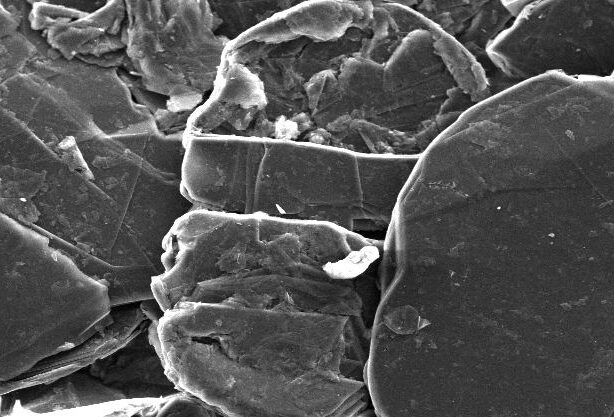
All graphite has a flaky morphology on some level, but in most instances the flake form has this structure regardless of particle size. The platy morphology is visible in the images above.
Petrological Environments
Large and small deposits of flake graphite exist around the globe, nearly always in metamorphic environments. The mineral is also, but rarely, found in igneous environments, and never in sedimentary environments; however, it potentially could be found in sedimentary systems as a product of erosion. Visit the Natural Flake Graphite Materials page to learn more about formation, processing, properties, and applications.